

Malawi Workshop | KidneyGenAfrica | Chronic kidney disease Africa | Genetics research in Africa | Capacity building and training Africa

Overview

Kidney disease is a major and growing health challenge across Africa, yet African populations remain vastly underrepresented in genetic studies of chronic kidney disease (CKD). Harnessing Africa’s unparalleled genomic diversity to understand kidney disease risk and improve patient outcomes requires both cutting-edge science and a new generation of African leaders in kidney genomics.

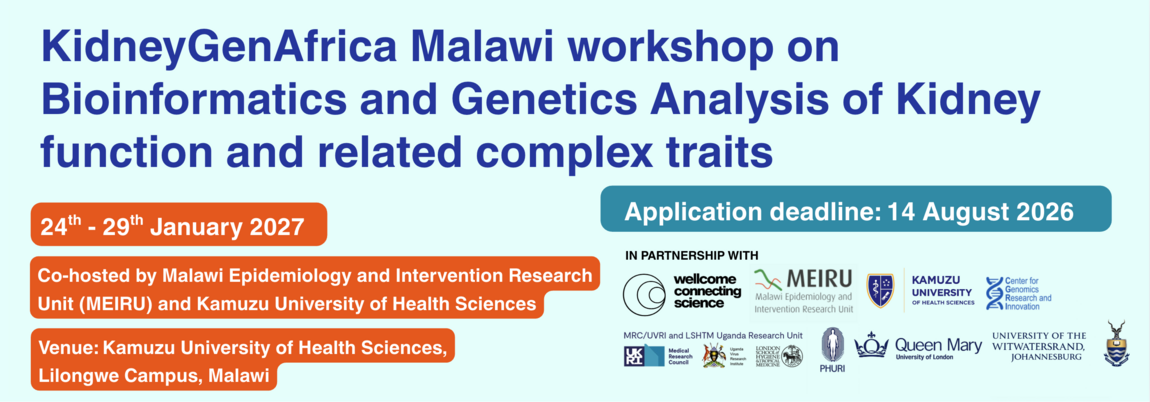
Following the success of our inaugural KidneyGenAfrica short course in January 2026, we are hosting another five day intensive workshop in Malawi. This workshop will bring together a diverse group of postgraduate and early-career researchers from across the continent to strengthen knowledge, practical skills, and collaborative networks in the genetic epidemiology of kidney disease. Participants will learn the foundations of bioinformatics, gain hands-on experience running GWAS and using PLINK, and explore kidney disease phenotypes, and evaluate shared genetic architecture between kidney function and related complex traits.

Through expert-led seminars, interactive discussions, and practical data analysis sessions, the course will provide a platform to examine ethical and community considerations in African genomics, share research across diverse contexts, and develop project proposals. Participants will leave with new technical skills, strengthened professional networks, and a deeper understanding of how to drive equitable kidney genomics research across Africa.

Learning outcomes

By the end of the course, the participants will be able to:

  1. Describe key kidney disease phenotypes, how they are clinically measured, and the genetic factors that contribute to disease risk across diverse African populations.
  2. Perform a GWAS pipeline and critically interpret findings in the context of African genomic diversity.
  3. Evaluate the shared genetic architecture of complex traits using genetic correlation and colocalisation approaches.
  4. Select appropriate methods, tools, and datasets to develop a feasible strategy for addressing a given research question.

Applications for KidneyGenAfrica Malawi Workshop now open

Deadline to apply: 23:59 GMT on 14 August 2026

Eligibility

Postgraduate and early career researchers working in Africa who are involved in bioinformatic data analysis, genetics, epidemiology or clinical assessment of chronic kidney disease and related traits, including geneticists and bioinformaticians transitioning from pathogen genomics to human genomics, are encouraged to apply.
Individuals who participated in the KidneyGenAfrica Workshop in January 2026 are not eligible to apply.

Key Details

Workshop dates: 24th to 29th January 2027
Co-hosted by: Malawi Epidemiology and Intervention Research Unit and Kamuzu University of Health Sciences
Venue: Kamuzu University of Health Sciences, Lilongwe Campus, Malawi
Deadline to apply: 23:59 GMT on 14 August 2026
Funding: Travel, accommodation, and subsistence fully covered

If you have questions, please email training@kidneygenafrica.org.
Application requirements

Please complete the online application linked below and submit a letter of recommendation to training@kidneygenafrica.org.
Training Committee & Instructors

Mia Crampin

Location

Malawi Epidemiology and Intervention Research Unit (MEIRU)

Bio

Prof. Mia Crampin is an epidemiologist and director of MEIRU. After graduating from a Bachelor of Medicine and Surgery from Manchester Medical school she became interested in Public Health and Epidemiology. Through an appointment at the London School of Hygiene…

Benjamin Kumwenda

Bio

Dr. Benjamin Kumwenda is an Associate Professor of Bioinformatics and Computational Biology and currently serves as the Director of Student Affairs at the Kamuzu University of Health Sciences (KUHeS), Malawi.

He is the Lead Principal Investigator for the Scottish Strategic Partnership…

Michelle Bishop

Location

Wellcome Connecting Science

Bio

With 20 years’ experience in genomics education in both Australia and the UK, Michelle leads the Learning and Training team within Wellcome Connecting Science. She oversees the strategic direction of the programme, has operational oversight of programme activities and leads…

Cristian Pattaro

Location

Eurac Research

Bio

Dr Cristian Pattaro is a researcher in biostatistics and genetic epidemiology. He has a Master's in Statistics from the University of Padova and a PhD in Biomedical Statistics from the University of Milano, he leads the Biostatistics and Epidemiology Group…

Michele Ramsay

Location

University of Witwatersrand

Bio

Prof. Michèle Ramsay is a geneticist at the University of the Witwatersrand, focusing on non-communicable diseases (NCDs) in African populations. She investigates genetic and epigenetic factors influencing obesity, hypertension, and kidney disease, integrating molecular and epidemiological methods. As director of…

June Fabian

Location

University of Witwatersrand

Bio

June Fabian is a nephrologist and clinical epidemiologist with a special interest in the epidemiology of chronic kidney disease (CKD) in Africa. She is the founding member of the African Research on Kidney Disease (ARK) Consortium, which includes collaborations across…

Segun Fatumo

Location

Queen Mary University of London & MRC Uganda

Bio

Segun Fatumo is Professor and Chair of Genomic Diversity at Queen Mary University of London and the Head of NCD Genomics at the MRC Uganda. He specialises in the genomics of African populations, applying approaches such as GWAS, Polygenic Risk…

Moffat Nyirenda

Location

MRC/UVRI & LSHTM Uganda Research Unit

Bio

Prof Moffat Nyirenda is director of the MRC/UVRI & LSHTM Uganda Research Unit. He holds a PhD in Molecular Medicine from the University of Edinburgh and is a Fellow of the Royal College of Physicians. His research explores links between…

Anna Köttgen

Location

Institute of Genetic Epidemiology University Medical Center Freiburg

Bio

Dr Anna Köttgen is a genetic epidemiologist with a focus on renal and metabolic diseases. She earned her medical degree from the University of Freiburg and a Master of Public Health from Johns Hopkins University. As Director of the Institute…

Sola Ojewunmi

Location

Queen Mary University of London

Bio

Dr. Oyesola Ojewunmi is a Senior Research Fellow in Genomics at the Precision Healthcare University Research Institute (PHURI), Queen Mary University of London, within the Genomics Diversity group led by Prof. Segun Fatumo. His research focuses on the genetic architecture…

Annette MacLeod

Location

University of Glasgow, UK

Bio

Prof MacLeod works on single-celled parasites called African trypanosomes. African trypanosomes present a significant burden to large areas of sub-Saharan Africa, leading to an estimated $1.3 billion annual loss to the African economy. The majority of this economic cost is…

Walt Adamson

Location

University of Glasgow, UK

Bio

Dr Walt Adamson is a Research Fellow and Lecturer at the University of Glasgow. His work focuses on how infectious diseases impact populations in sub-Saharan Africa and its diaspora, with a particular emphasis on the humanAPOL1 gene and the roles its variants play in…

Susan Kanjira

Bio

Susan Kanjira is a PhD student at the university of Edinburgh and based in Malawi at Malawi Epidemiology and intervention research unit (MEIRU). Her research focuses on understanding the genetic underpinnings of various psychiatric conditions in individuals of African ancestry.…

Jean-Tristan Brandenburg

Location

University of Witwatersrand

Bio

Dr. Jean-Tristan Brandenburg has a broad range of interests in molecular bioscience and human genomics, with a growing focus on kidney disease. His research applies bioinformatics to address complex genetics problems and analyse large-scale genomic data. Over the years, his…

Abram Kamiza

Bio

Dr. Abram Kamiza is a genetic epidemiologist whose research focuses on understanding the genetic and lifestyle determinants of cardiometabolic diseases and cancer in individuals of African ancestry. His work aims to address the underrepresentation of African populations in genomic research…